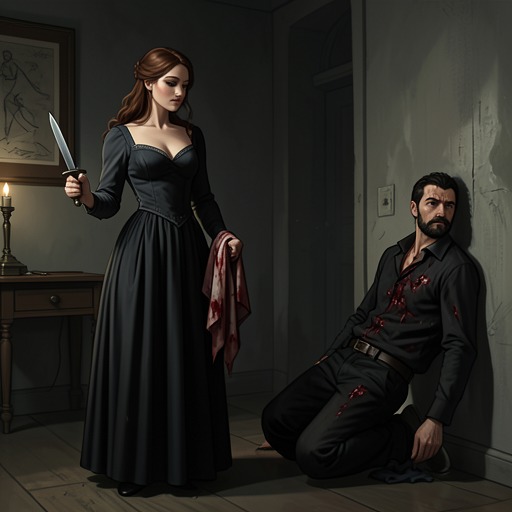
Vlad Dracula
The Tale of the Vampire BrideVlad Dracula is the novel’s central supernatural ruler and its most persistent force of captivity, desire, and political ambition. Introduced as the apparently aristocratic host of Dracula’s Castle, he gradually discloses himself as an immortal prince and vampire Master whose authority reaches across the castle, its household, and the surrounding domain. His decisive project is to possess Glynis Wright as bride, servant, accomplice, and bridge to a new life in England; yet the very blood-power with which he claims her also creates the conditions for his defeat.
Identity and Introduction
Vlad first enters the narrative through voice and title. He welcomes Earl Wright before the expected arrival, speaking with a low, seductive authority that carries the accent of the country and chills Glynis Wright. When the family meets him, he gives the name by which the supernatural world knows him: Dracula. His sensuous smile and burning eyes establish attraction and threat in the same gesture, while his later correction of the family’s assumptions expands the identity behind the title. He explains that he is not truly a count but Prince Vlad Dracula, a prince whose family no longer rules the country. His long, strong hands and unusually long nails provide an early bodily sign that the aristocratic visitor is not entirely human.
The novel repeatedly makes Vlad name himself, as if each title were another layer of possession. He identifies himself as Vlad Tepish and Dracula, immortal, prince, and Glynis Wright’s new Master. Elsewhere, he simply declares, “I am Dracula,” while the name Vlad Tepes and the epithet the Impaler connect his private presence to a violent historical legend. The accumulation matters: Count Dracula is the socially usable title, Prince Vlad Dracula the displaced political identity, and Master the supernatural relation he imposes upon Glynis Wright. His identity therefore joins lost sovereignty, aristocratic performance, and vampiric command rather than allowing any one of them to explain him completely.
His physical appearance reinforces that composite identity. He is seen in a long black coat, with long auburn curls, an unusually long mustache, unearthly pale flesh, green eyes that flicker like a cat’s, and two conspicuously long teeth. Dark power pulls Glynis Wright’s gaze toward him even as she resists it. The image is not merely monstrous; it is theatrical. Vlad enters as a figure who knows how clothing, hair, posture, voice, and aristocratic address can make predation appear as elegance. His menace depends on the fact that seduction and terror are never separate stages of his presence.
Rule, Power, and the Castle
Vlad’s authority is institutional within the hidden supernatural world. He explains that he was once a mortal prince, but becoming a vampire subjected him to the curse of daylight. As a mortal, he had not understood the full cost of that choice; afterward, he struggled for years to regain his princedom but could never recover enough influence to secure the throne. The lost crown becomes the political wound beneath his supernatural mastery. He cannot restore the old kingdom directly, but he can command the territory around Dracula’s Castle: any vampire entering his domain must respect him as Master or face death.
This authority is enforced through hierarchy and example. Vlad has three brides, including Cneajna, Ariana, and Elina, and Glynis Wright is brought into the same structure as his first bride. When Glynis Wright resists the role assigned to her, the castle becomes a school of rules and a prison of repeated commands. She recognizes that she is a slave to Vlad Dracula and that her new life consists of surviving the castle until escape becomes possible. His power does not depend only on physical force; it is embedded in titles, duties, clothing, movement, feeding, and obedience.
Vlad also defines vampirism as a system of collective violence. When Glynis Wright questions the killing of mortals, he answers that vampires kill mortals and that it is their way. The statement turns custom into justification. His authority is presented as natural because it is repeated as law, while the castle’s order depends upon subjects accepting the identity he has assigned them. Cneajna’s insistence that Glynis Wright must go because it is her duty shows how Vlad’s commands circulate through the brides themselves. The Master’s power is therefore both personal and social: he makes obedience appear to be the proper behavior of a bride.
The castle also exposes the limits beneath his command. Vlad must sleep by the curse of daylight, and he cannot simply move through the mortal world without adapting his plans to the restrictions of vampirism. His domain is broad, but his existence remains bounded by supernatural conditions. That contradiction—absolute local mastery joined to dependence upon the rules of the curse—helps explain his obsession with constructing a life elsewhere under mortal appearances.
Glynis Wright, Marriage, and Coercion
Vlad’s relationship with Glynis Wright develops through a deliberate conversion of attraction into ownership. He presents her as wife and bride, but his language repeatedly removes consent from those terms. He tells her that she is his wife and that he will not share her with anyone; she is his. He also calls her his first bride and imagines creating a life with her beyond the existing one. Marriage, in his hands, is not a mutual domestic arrangement but a supernatural claim backed by blood, command, and punishment.
His methods range from seduction to explicit terror. When Glynis Wright seeks death as an escape, Vlad threatens a punishment worse than killing: torture and a living death from which death will not come. He compares her situation with that of another woman he once loved and banished after betrayal, converting past intimacy into a warning. His violence is possessive rather than incidental. He does not merely want Glynis Wright to remain alive; he wants her to remain available to his will, conscious of the power that can destroy, transform, and restrain her.
After Glynis Wright becomes a vampire, Vlad makes the blood bond the foundation of his control. He insists that he is her Master because his power created her and can control her. Even when vampiric madness overwhelms her rational thought, he claims that his power remains capable of directing her. He orders obedience even if it requires killing her brother, Andrew Wright, and weaponizes her earlier killing of her mother, Antoinetta Wright, as proof that she has already crossed the boundary he wants her to accept. The command is psychologically calculated: Vlad seeks to make Glynis Wright interpret guilt as evidence of belonging to him.
His view of Glynis Wright is also practical. He tells the Baroness that he needs her in order to move to England and establish a mortal life there. Glynis Wright can give him the life of a mortal man. This explanation clarifies why the marriage claim is bound to his political and social project. He wants an estate in London, an aristocratic existence, and a household credible to mortals. Glynis Wright is not only desired; she is required as the visible human element in the identity he plans to perform.
That plan forces Vlad to turn Glynis Wright into an instrument of deception against Andrew Wright. He arranges a journey to Buda, directs that Andrew Wright stay with Sir Stephen Sheridan, and instructs Glynis Wright to present herself as Countess Dracula of Wallachia. He orders her to conceal recognizable English possessions, wear dresses bought by her mother in Paris, accept Erzsébet Dolingen’s jewels, and cover her face with a specially made veil. In Buda, the veil must remain on whenever Andrew Wright is present. Clothing and title thus become technologies of captivity: the Countess’s appearance is designed to confirm Vlad’s story and prevent Glynis Wright’s brother from recognizing the woman behind it.
Political Ambition and Relations with Others
Vlad’s plan to move to England reveals a ruler trying to translate supernatural power into modern aristocratic respectability. He tells Glynis Wright that he has long intended to leave his home and establish himself in London as an aristocrat and gentleman. The project is not a simple change of residence. It requires an estate, a credible marriage, concealment of vampirism, and a social identity that can pass within mortal society. Glynis Wright’s body, title, and family connections are all recruited into that construction.
His relationship with Andrew Wright is consequently shaped by manipulation and threat. Vlad knows that Andrew Wright has written to his solicitor in Buda, and he answers the investigation by manufacturing a marriage narrative and a cover story about loss in an accident. He warns Glynis Wright that if she destroys the English plan, he will torture Andrew Wright to death and feast on his blood as he did her father, Earl Wright. Andrew Wright is both obstacle and leverage: protecting him becomes one of the means by which Vlad tries to force Glynis Wright into obedience.
Vlad’s connection with the Baroness is similarly instrumental. In her room, beside the body of a young woman bearing vampire bites, he explains that Glynis Wright is necessary to the English scheme. Desire and politics overlap in this relationship, but neither is presented as independent of power. The Baroness is an associate within the vampire world, while Glynis Wright is the chosen human-facing wife whose presence can make Vlad’s planned reinvention credible.
His bonds with the brides expose another dimension of his rule. Ariana feeds a weakened sister by disgorging blood into her mouth, an exchange that shows the brides’ collective survival operating through Vlad’s household structure. Yet Vlad’s claim over Glynis Wright as first bride destabilizes that arrangement. By declaring her uniquely his, he turns the plural household into a hierarchy of preference and competition. Glynis Wright’s position is therefore both elevated and endangered: she is granted distinction as the first bride while being isolated under the Master’s exclusive claim.
Vlad’s relation to Ignatius is marked by rivalry and threatened authority. Ignatius suggests that embracing vampiric identity could make Glynis Wright a more powerful helpmate, a possibility that reframes her power outside simple submission to Vlad. Vlad reacts to any independent danger in Glynis Wright by asserting that he is the most dangerous creature in the room. The exchange reveals the insecurity within his dominance: he must repeatedly announce supremacy because Glynis Wright’s developing strength, her ties to others, and her capacity for choice all threaten the closed system he has built.
Violence, Protection, and the Final Reversal
Vlad’s violence reaches beyond Glynis Wright to her family. He invokes the death of Earl Wright as a precedent and uses the threatened destruction of Andrew Wright to make the English plan appear unavoidable. His cruelty is thus both punishment and administration: terror removes alternatives, while the promise of an aristocratic future supplies a polished surface for the same coercion.
Yet the final conflict gives his possessiveness a visibly protective form. When Cneajna raises a dagger against Glynis Wright, Vlad enters like a storm, knocks the weapon away, and grips Cneajna by the throat. He declares that he will kill Cneajna and then leave, swearing that he will never again allow another person to harm Glynis Wright. The scene does not redeem him. Protection remains inseparable from ownership, since he is defending what he has already named as his. His promise reveals the emotional intensity of the bond without dissolving its violence.
Glynis Wright finally turns that possessive bond against him. As Vlad looks over his shoulder, she acts “For my family,” making the act of resistance explicitly answer the deaths and threats that have defined his rule. Vlad’s power, his household, and his claim to her do not survive the reversal. As he dies, he manages to tell Glynis Wright that he loves her before his eyes become milky and staring. The ending preserves the contradiction at the core of his character: the Master who has made love into captivity is capable of naming love only at the moment his control ends.
Vlad’s death is therefore not merely the fall of a monster but the collapse of a political and marital system. He wanted Glynis Wright to be Countess Dracula, his first bride, and the guarantor of his English future. Instead, the woman he created becomes the agent of his destruction. His legacy remains in her transformation, her blood-power, and the supernatural identity he forced upon her, but those inheritances no longer secure his authority. The creator becomes the source of the created subject’s final independence, and his most intimate claim becomes the route by which Glynis Wright escapes it.
Narrative Role and Significance
As a character, Vlad is built around a recognizable idea—the seductive tyrant—but the plot repeatedly complicates that apparent simplicity. He is simultaneously displaced prince, vampire sovereign, household patriarch, lover, political strategist, jailer, and creator. His actions follow a coherent objective: restore status by extending control from the castle into mortal society. The surprises arise not because that objective disappears, but because intimacy, jealousy, fear, and genuine attachment make its execution unstable.
His governing metaphor is transformation. Vlad transforms himself from mortal prince into immortal vampire; transforms Glynis Wright from daughter and English gentlewoman into bride and vampire; transforms a castle into a kingdom; and plans to transform London into the stage for a concealed supernatural aristocracy. He also uses transformation as punishment, threatening a living death and reshaping identity through blood. Against him, Glynis Wright’s arc becomes a counter-transformation: she moves from imposed title to self-directed action, carrying the powers of his world while rejecting his right to command her.
The result is a Gothic portrait of authority that depends on performance as much as force. Vlad’s coats, titles, veils, jewels, marriage language, and aristocratic plans all attempt to make domination look like order and possession look like belonging. But the performance repeatedly exposes its own violence. The prince cannot recover his throne, the husband cannot secure willing partnership, and the Master cannot prevent the bride he created from becoming his executioner. Vlad Dracula remains powerful precisely because the novel allows his menace, longing, and historical grandeur to coexist; he remains defeated because none of those qualities can finally produce consent.